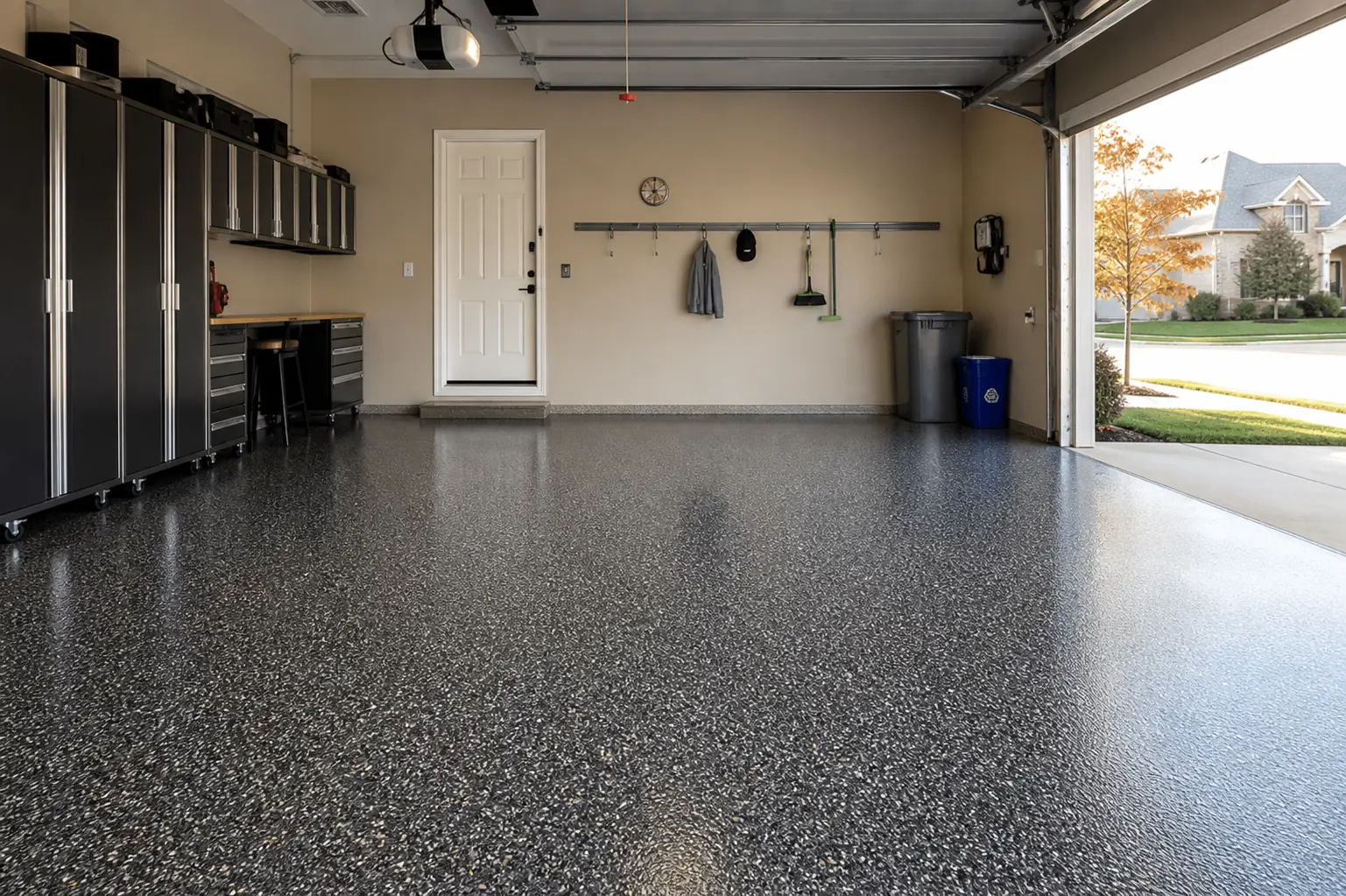
Garage floor joints need to be identified before coating. A moving expansion or isolation joint should retain a detail that accommodates movement; it should not be treated like an ordinary surface crack. A control joint may need a different approach. Ask the installer to mark each joint and explain the proposed treatment in writing.
The straight line running across your garage might bother you more than the oil stain. A flake finish can disguise color differences, but it does not make the slab one continuous piece. The useful question is what the line does, not whether the installer can hide it.
Which line are you looking at?
| Feature | What to discuss | What a quote should explain |
|---|---|---|
| Saw-cut or tooled control joint | Its purpose, condition, and whether movement is expected | Filler choice and whether the finished joint remains visible |
| Expansion or isolation joint | Separation between slab sections or adjacent structures | How the detail permits movement through the finished surface |
| Irregular crack | Width, recent change, moisture, or displaced edges | Repair limits and whether another evaluation is needed |
| Damaged joint edge | Loose concrete and wheel traffic across the edge | Edge repair scope before the coating is installed |
Do not classify the line from a photograph alone. A sealant-filled gap beside a wall, a saw cut through the middle, and a random crack may require different materials. If an edge has lifted or the crack is changing, ask whether the coating contractor can assess it or whether you need another qualified professional first.
Why garage floor expansion joints should not disappear into a coating
Floor finishes need a joint detail that matches the substrate. Sherwin-Williams' Resuflor Deco Quartz instructions distinguish non-moving joints from isolation or expansion joints and specify a flexible material for the latter. That example is a product-specific requirement, not a universal filler recipe for every garage.
Ask the provider to show where the coating terminates or how the finished joint is maintained. Get the proposed material name, color, and sequence. A dark joint through a light flake field may be visible. Decide that detail before the surface is prepared rather than asking for a cosmetic patch afterward.
Joint treatment and crack repair are different line items
A quote that says “all cracks filled” may say nothing about moving joints. Ask for separate descriptions of crack repair, joint-edge repair, and joint treatment. Note whether old filler must be removed and whether that removal is included.
The concrete crack repair guide explains the separate repair discussion. Neither a repair nor a coating should be sold as a guarantee that future substrate movement cannot show through the finish.
What should the completed detail look like?
Ask for a drawing or a photograph of the proposed detail from the actual provider. Confirm whether the joint remains recessed, sits flush, or gets another designed finish. Discuss its location relative to your parked tires, rolling cabinets, and the route you walk with groceries. Those are useful project details, even when the joint's appearance is a small part of the floor.
For a Palm Beach County garage with rainwater tracked across the entrance, discuss cleaning and drying around the joint as well as the flake texture. Decorative flakes do not by themselves establish the wet traction of the completed system. The garage floor traction guide helps frame that separate decision.
Photograph the joints before you request an estimate
- Take a wide photograph showing where each line begins and ends.
- Add close-ups of damaged edges, old filler, or signs of moisture.
- Record anything you have noticed changing; do not scrape or fill the gap to improve the photo.
- Ask the provider to identify the lines during the site assessment and add the treatment to the proposal.
Keep those photographs with the written quote. They provide a reference for what was visible when the scope was agreed. Avoid turning a visual observation into a diagnosis: “water collected here after rain” is useful; “the slab needs a vapor barrier” requires an assessment.
Questions to settle before choosing a seamless look
Will any joints remain visible? Which materials are compatible with the coating system? What happens if a repaired crack moves again? Is joint maintenance covered by the coating warranty or handled separately? An answer that mentions only the final color leaves the most important detail unresolved.
Request an assessment of your garage floor and joints. Include the joint photographs and your city. Review garage floor coating options once the slab and its movement details are understood.